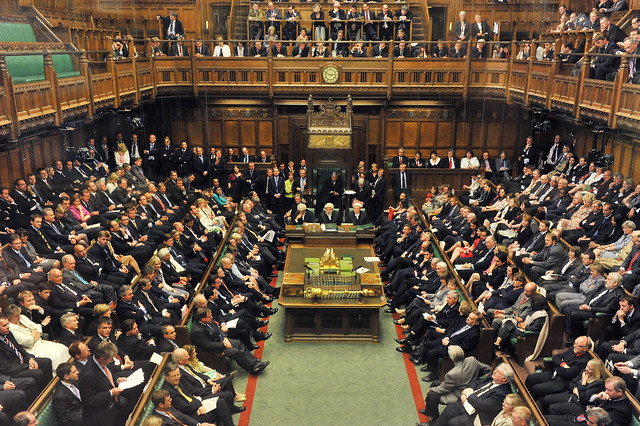
Showing posts with label Parliament. Show all posts

Thursday, 7 February 2013

An Open letter to Anne Main MP


Mrs Anne Main                                                                                                                   05/02/13
House of Commons
London
SW1A 0AA

Dear Mrs Main

I write today with the second reading of the Marriage (Same Sex Couples) Bill in mind. I have followed today’s debate with great intrigue, listening where I can to MPs speeches on the issue of equal marriage. Debates such as these make me proud of our Members of Parliament; typically the floor of the House is embarrassingly empty, however today the level of involvement on the floor of the House has made me proud of our democracy, for someone with a fondness of Parliament, it is nice to see MPs and indeed you involved in the debate.

However I am upset to see you voted against the Bill.

I understand the points you made during the debate; you are correct that it featured in neither of the coalition party’s election manifestos hence there is no mandate to legislate on this issue. This does not suggest however that you the elected legislature cannot govern on the issue. Indeed, this is a conscious issue where you the MP must uphold the Burkean (after statesman Edmund Burke) principle of voting in the best interests of your most loyal constitutes of whom you represent.

This is wrong. In entrusting you with the Burkean principles of representation, we the people of St Albans expect more than just a representation of St Albans interests. We expect you to be better, in standing up and arguing for what is fair and is what is right. I find it hard to believe that the UK can denounce countries who murder people for being gay, yet fail to recognise the right of man to love someone of the same sex in the act of marriage.

Indeed, during the debate I was moved by the words of David Lammy MP (Tottenham) who argues that we cannot be “separate and equal.” I refer you to the words of Salmon P. Chase, who in the aftermath of the passing of the Kansas-Nebraska Act in 1854 said “There can be no Democracy which does not fully maintain the rights of man, as man.” While speaking on an issue of slavery (which has since been abolished in the US gladly) I wonder if his words can indeed be echoed today as well. How can we knowingly walk down the street, shoulder to shoulder, with homosexuals of whom we deny the joyous celebration of love that is marriage between two individuals?

While I respect your views to be your own, I urge you to clarify your position on this issue, and your reasons for voting against the Bill, by releasing a press-release on the issue and perhaps publishing your reasons in the local newspaper so your most loyal constituents can comprehend your reasons in obstructing this progressive piece of legislation. 

Yours Sincerely,


A St Albans constituent

Saturday, 7 July 2012

An Elected House of Lords is a recipe for disaster

The temptation to write what would possibly be my fourth "film-related" post was, trust me on this, incredibly tempting. However, for the meantime I shall delay said idea for a blog and return to my blogging roots, harking back to a time when all I bored you with was politics. Compared to my essays on the subject, i'm going to dumb it down a touch, just so it can appeal to world en masse (2,250 hits worldwide in just over a year, whoop whoop).


To my dismay, the Government's House of Lords Reform Bill is set for its second reading on the coming Monday (9th) and Tuesday (10th of July 2010). [I ought to mention to those who don't know, a Bill is a proposal for a policy to be enacted into law, to put it simply]. This is an incredibly important part of the process of law making. The first reading is merely an announcement of the proposed legislation. The second reading however is the meat and drink of the legislative process: The House of Commons will debate and then vote on the issue. Expect there to be fireworks between what should be a particularly busy House of Commons. 


Indeed, unlike other Bills, this is particularly important because it has the potential to change the constitutional framework of the United Kingdom. Now, the United Kingdom doesn't have a written, codified constitution. The United States are of course the prime example of a country that does have such a document, which is often why you hear many controversial issues described in America as "Unconstitutional". The UK, does have a constitution of sorts (that is, an idea of how the country should be run), but it is not found in one place, it is found in several, in Acts of Parliament produced over hundreds of years. Naturally, these Acts of Parliament  get old, and Political Parties tend to fight elections on the basis that they need updating. Classic examples would be an Act of Parliament allowing marriage only to be between a man and a woman; many years ago this was fine, but as countries and indeed democracies develop, opinion changes, and in 2005 an updated Act was passed to allow marriage to also be allowed between same-sex couples. 


Coming back to the reason for the blog, the three main parties (and this happens very rarely) all agree that the House of Lords needs to be updated to be more aligned to  other aspects of the modern political framework. The House of Lords at present is unelected, members exist by virtue of nomination. This is deemed undemocratic by the party machines that exist in the UK. Naturally, the word "undemocratic" is incredibly inflammatory to the public, because often "undemocratic" and "dictatorship" are found very close to each other in the political dictionaries around the world. 


Of course, changing it would be great, but I shall highlight three problems with making the House of Lords an elected chamber:


  1. It will be party dominated - much like the House of Commons, anyone who wants to stand has a better chance if backed by a party. Indeed, anyone can stand for the Commons (famously, Katie Price once stood for election as an MP). However, the electorate tend not to vote for independents and smaller parties. In the bigger picture, they see 1 of at most 3 parties getting into Government, and setting the legislative agenda. A vote for an independent is considered a wasted vote, because of the support that the steam rolling major parties can create. Indeed, the House of Lords at the moment consists of a vast array of intelligent, independent minded members, who contribute massively to the legislative process. People will not go to the polls and vote for Mr Independent on the basis he has contributed massively to medical research (as he would have been nominated to the Lords for). Instead, they will vote for the party, as people do time and time and time again in the House of Commons. The Lords would just mirror the House of Commons in terms of its composition. You think legislation is fastracked through the Lords at the moment? Imagine how quick it would get through, with a Majority in both Commons and the Lords. 
  2. They will have an elected mandate - Gordon Brown as Prime Minister never won an Election as a party leader, hence he was Prime Minister without an "elected mandate" for his Premiership. This damaged his credibility severely, because of the way he inherited his post as PM. Indeed, if the Lords are elected, they will carry an elected Mandate into their role. Great! Wrong. Lords will have been elected in the UK by a proportional system of voting. This is widely accepted as a fairer system, because the amount of votes received tends to equate to the amount of members elected (i,e, if Labour recieve 25% of the vote in the Midlands, expect 25% of Labour candidates from the Midlands to be elected to the Lords). Without wishing to debate the merits and demerits of the system, there is a consensus that a PR system is fairer than the system in place for the House of Commons: a Single-member list system. If members are elected by a fairer system, what is there to stop members saying "Hang on a minute, we're here fairly, you lot [in the House of Commons] have been voted in via safe seats and on 36% of the popular vote, what we say is far more legitimate than what you say!" The point is, the Lords may well get into a position where it is superior to the Commons, which would upset the political system of the UK (the Prime Minister would thus be drawn from the "unfair" House of Commons).
  3. Loss of expertise - I pose the question, will my University Professor stand if the House of Lords become elected? Well, I did ask him that and he said he wasn't sure. In reality, as a Conservative member of the House of Lords, he would only be able to stand if endorsed by the Party. Punch Lord Norton into Wikipedia, and you will find the quote  "the United Kingdom's greatest living expert on Parliament". At the moment, he can weigh in during the legislative process, something i quite like the idea of, particularly if the debate is with regards to anything about our political system. An elected House may well exclude such experts, as indeed its very much down to the parties as to who gets in and who doesn't. It would become a chamber not so much of experts, but loyal party candidates, who are more than willing to vote inline with the party. At present there is a very lax whipping system in the Lords, regardless, there is no majority in the Lords because of the existence of 181 independent cross benches. 
Indeed, I would suggest three good arguments, as to why the Lords should be kept as it is. 

Tuesday, 27 March 2012

Parliament, Take Two.

Last week, on Wednesday 21st March I found myself in Parliament for the second time this academic year. The wider scope of the day was to basically smile and nod a lot as my perspective employers sized me up as whether or not I would be suitable to work at Westminster next year, my Placement year. However, these activities would not begin until 2pm, so i was free to do as i pleased until that time.

Oliver Cromwell, the catalyst of change that brought power back go Parliament
I turned up very early, being budget day and Prime Ministers Question's being on, i anticipated a lengthy wait to get in, queues all round the place. I was very wrong. After a 30 minute commute, it took me only 5 minutes to get from the Visitors entrance, through security and to the admissions office where i had to pick up my tickets for Prime Minister Questions.

I decided rather than to sit idly in the cafe for a few hours, i ventured up to one of the Committee Rooms and sat in on the Education Committee's evidence session on how best 15-19 year olds should be tested. Most if not all of the spiel was well over my head, however one exchange did prick my ears up. They were discussing how some courses such as module based GCSE courses offer "Easy Routes" to get good grades. What this means is of course a syllabus is set and it is up to the school to choose how to teach it. They want to change the "easy routes" course to make it more challenging, rather than getting "safe" marks and safe grades. Now up until this point, you may not have found this story that interesting, however, other than module based courses they also mentioned another GCSE that was offered too many easy routes. You can guess what is coming. Yes, Geography, the infamous "Colouring in" course, defended by those who take it and slammed by those who don't for being a weak subject. Well, i'm sorry, but it would appear it is official, Geography is just "colouring in".

I left the committee at about 11am, where more fun was to be had. Having just left the Committee Room, i was summoned back by one of the Committee Room attendants, where we had the following exchange:
State Opening of the Commons after the 2010 Election

Attendant: Are you Press?
Me: No.
Attendant: General Public?
Me: Yes.
Attendant: You think you can just help yourself to water?

Now, an brief explanation. When i entered the room i was ushered into a seat on the side of the room. The room was reasonably full, but not over flowing so i did not really think anything of being sat in a different position to all the other observers. In front of me, were glasses and a bottle of House of Commons branded water. Being a very old building made up of a lot of windows, it was quite hot, and i helped myself. Now, back to our exchange:

Me: Excuse me?
Attendant: You cant just help yourself to water, its meant for Press and official visitors. (This was said quite aggressively)
Me: Well, i was told to sit there and i saw everyone else helping themselves to it so i just assumed...
Attendant: Yes it was our mistake to sit you there, but water isn't for general public.

And that was that, he wandered off back into the room and i was left wholly perplexed. I didn't worry too much about it, my thirst was positively quenched.

I then made my way down to the Central Lobby. There all visitors loitered, waiting for the Chamber to be opened. Sure enough at 11:30 rumbling voices became hush as one of the Clerks shouted "SPEAKER" loudly down the corridor. The mass of people parted and the speaker, clerks and ceremonial mace walked through toward the Chamber at a slow pace, the speaker graciously smiling at the visitors.

Up the the gallery we went. A long queue meant i didnt get in until 5 to 12, at which point the Chamber was already buzzing, full the brim with MPs waiting for the Prime Minister to show up and answer questions.

While PMQs itself was not particularly spectacular, the atmosphere was still electric, a gladiatorial showdown between Left and Right. I would say the Conservative won the bout, Ed Milliband never really got into a stride because his questions were bi-partisan "Support of withdrawal of troops" rather than political attacks. David Cameron made a jibe about Ken Livingstone, which went down well with the Right and hence probably edged him to victory in the competition that is PMQs.

Then, the budget. Interestingly, the Speaker left the chamber, the reason because the Speaker and his Clerks are servants of the King or Queen. And as of the Glorious revolution of 1688, the King/Queen is no longer trusted with the money, so convention dictates they leave the chamber for the budget.

Osborne led with an hours discussion about the details of the Budget, which at times was met by cheers from the Tory backbenchers, waving their notes in the air as they did. At others, Labour jeered, indeed Ed Millibands quip about a Millionaires Budget went down grandly with the opposition.

The good bits where built up with an increase in his tempo and volume, with the occasional fist crashing against the dispatch box. Of course, when he retired down, withdrew himself and his body language, it was obvious he was revealing a measure of taxation that would not be popular. Overall however, his delivery was quite good.

Messer's Osborne and Alexander's work within the famous red box
Unfortunately however, i could not stay for long, as i had other business to attend to, which involved Q and A sessions with various MPs and dignitaries, including Baroness d'Souza and Robert Rogers, Clerk of the House of Commons (and author of How Parliament Works). It was a great day, and i would recommend a visit to anyone who has not been. It is of course a public building, paid for by the tax payer.